


Page 138 - Exploring Taste Magazine N.2
P. 138
EXPLORING TASTE—SANTA MARGHERITA GRUPPO VINICOLO


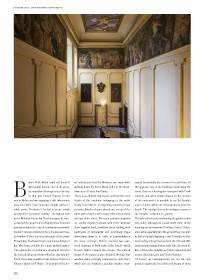
                  efore 1645, Milan could not boast of   est architecture that the Milanese can enjoy while   rupted horizontally by a cornice for each floor. At
                  what would become one of the great-  walking down Via Santa Maria Valle, in the down-  the opposite side of the building, overlooking the
                  est examples of baroque art in the city.   town area of Piazza San Babila.   street, there is a rectangular courtyard with Doric
          B In  that  year  Giovan  Battista  Durini   There is an element that stands out from the main   columns and other simple shapes. In the corners
          was in Milan and was enjoying a rich inheritance   facade  of  the  residence  belonging  to  the  noble   of  the  courtyard  it  is  possible  to  see  the  family’s
          from  his  father,  Gian  Giacomo,  though  without  a   family  from  Monza:  its  imposing  rusticated  main   coats-of-arms, which are curiously absent from the
          noble status. To obtain it, he had to create a work   entrance (blocks of stone placed one on top of the   facade. The courtyard is not the only green space in
          worthy of the “generous” nobility – the highest rank   other and in relief, used in many other architectural   the complex - behind it is a garden.
          in the Milanese hierarchy. For this reason, he com-  settings of the time). The main entrance supports   The side of the house overlooking the garden is also
          missioned the project of an elegant palace from not   an  equally  majestic  balcony  with  three  windows   very  sober,  although  its  rooms  boast  some  of  the
          just any architect but one of Lombardy’s most well-  close  together  (and,  therefore,  more  visible),  with   most important treasures of Palazzo Durini. The pi-
          known: Francesco Maria Richini, the ten-year mas-  pediments  of  rectangular  and  curvilinear  shape   ano nobile especially (and the ground f oor too, with
          ter builder of the Duomo at the peak of his career.   alternating  above  it.  In  order  to  counterbalance   its hall and a vault depicting Love’s Triumph) is char-
          Presumably, he showed Durini a previous design of   the  iconic  entrance,  Richini  inserted  two  rusti-  acterized by ceiling frescoes from the 17th and 18th
          his, which was suitable for a nine-window palace.   cated elements at both ends of the facade, which   centuries portraying Aeneas and Dido, the seven la-
          The initial idea, recorded in a document stored in   become  lighter  towards  the  cornice.  The  vertical   bors of Hercules, Achilles and other characters and
          the Raccolta Bianconi book collection, was very dif-  thrust of the palace is also obtained through four   scenes of ancient Latin and Greek literature.
          ferent from what would become Palazzo Durini or   window styles, perfectly connected to each other,   Of  course,  we  contemporaries  are  not  the  only
          Palazzo Caproni di Taliedo - an example of the fin-  which  give  its  elevation  a  peculiar  rhythm,  inter-  guests to appreciate the colors and beauty of these


          136

